
When imagining a traditional classroom setting, what comes to mind? Common images might be: a teacher at the front of a classroom; students sitting attentively at desks; a square room with posters or screens on the walls. While not uncommon in the American education system, those impacted by and invested in education rarely question the unspoken narratives perpetuated in traditional classroom environments. Some narratives that often go unacknowledged are: the teacher is the “expert” and authority in a learning environment; students should be quiet, still, and submissive to show respect; and learning should happen indoors in a controlled space. What would happen if these narratives were disrupted? What if the walls were taken down and nature became the classroom? What if teachers let go of some control to let the Land lead? And, what if students were seen as active co-creators in their learning, free to express their ideas, explore their environment, and follow their curiosities?
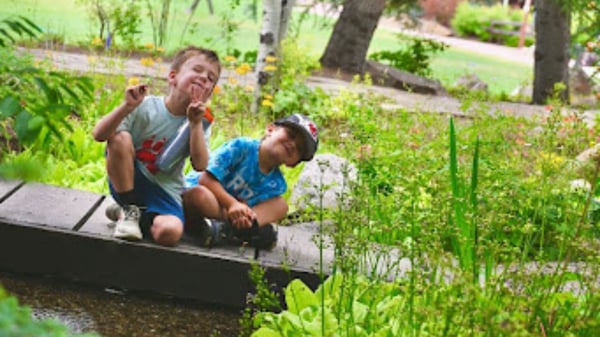 Walking Mountains summer campers sitting by the creek at Betty Ford Alpine Gardens.
Wild Pedagogies offers a pedagogical approach for educators to wild their teaching practices by shifting away from traditional approaches to education and to interrogate the belief systems behind these approaches. Arising first in Canada in 2014, Wild Pedagogies calls for significant cultural change through education to disrupt the current pace of environmental destruction by fostering stronger human-nature relationships within education itself (Jickling et. al, 2023, p. 1-2). Wild Pedagogies is based upon eight touchstones:
- Nature as Co-Teacher
- Complexity, the Unknown, and Spontaneity
- Locating the Wild
- Time and Practice
- Cultural Change
- Forming Alliances and Building Community
- Learning That is Loving, Caring, and Compassionate
- Expanding the Imagination
To dive deeper into each touchstone and learn more about Wild Pedagogies, read An Introduction to Wild Pedagogies.
Walking Mountains was first introduced to Wild Pedagogies by former graduate student Katie Geraci, who implemented Wild Pedagogies into Field Science programs with school groups as part of her capstone action research project. While Walking Mountain’s Field Science programs already take place outdoors, Geraci still found that she and other graduate students were “reproducing a traditional indoor classroom experience for students, but outside,” which is what led her to find Wild Pedagogies (Geraci, 2024, p. 4). Geraci chose to focus her research on the question, “Can Wild Pedagogies and learning standards coexist in outdoor environmental education programs?" (Geraci, 2024, p. 5). Her findings: yes, and. While her research showed that there were some time limitations to implementing Wild Pedagogies in short, four-hour school programs, “learning outcomes were [still] comparable to a typical teaching day,” and Wild Pedagogies “enhanced human-nature relationships by considering the intrinsic value of nature” (Geraci, 2024, p. 60). Her research showed that implementing Wild Pedagogies not only satisfies learning goals but also deepens students’ relationships with nature. This is important because, as stated by Orr (2017), “students come through their formal schooling [either] as more clever vandals of the Earth and of each other, or as loving, caring, compassionate, and competent healers, restorers and builders to a decent, durable and beautiful future” (p. xi-x). At Walking Mountains, we want to cultivate learners who embody the latter.
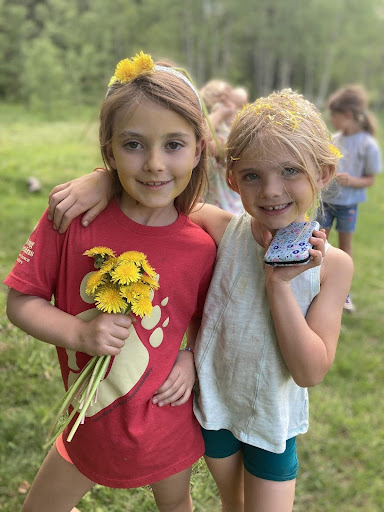 Walking Mountains summer campers adorned with dandelions during a Summer Science Camp.
Geraci’s action research project provides a shining example of how Walking Mountain’s graduate students influence the non-profit’s programs during their tenure in the Foley Graduate Fellowship; Wild Pedagogies is now being expanded upon and further tested by current graduate students in the fall Program Planning and Design Class. Graduate Programs Manager and Faculty, Annie Henderson, and Senior Youth Programs Manager, Cassy Jo Brown, met before the fall class to brainstorm a new class plan for this year’s cohort based on foundations that the goals of Wild Pedagogies better align with Walking Mountain’s mission (to awaken a sense of wonder and inspire environmental stewardship and sustainability through natural science education) compared to traditional educational methods. During the fall class, fellows update existing Summer Science Camp curricula, which are taught by the graduate students themselves the following summer. This fall, the focus is to implement Wild Pedagogies into the camp curricula, as Summer Science Camps give educators the opportunity to be with students for a whole week (compared to 4-hours in school Field Science programs), allowing more time for the eight touchstones to be met holistically.
Notable observations from the graduate student’s curriculum projects so far have been: less reliance on non-natural materials that create waste (shifting towards nature-based materials); more inquiry-led activities that follow the student’s curiosities (emergence); efforts to encourage students to learn directly from the Land rather than about the Land; and more emphasis on Indigenous pedagogy and perspectives. The ‘27 graduating cohort, Justin, Alli, Maggie, and Mitchell, are looking forward to testing out their new curricula this summer, and Walking Mountains is excited to be at the forefront of implementing Wild Pedagogies in environmental education.
Written by Cassy Jo Brown. Cassy Jo is the Senior Manager of Youth Programs at Walking Mountains. She is a mentor; educator; and lifelong student of the Land.
References
Geraci, K. (2024). Pace and Place: Enacting Wild Pedagogies in Standards-Based Environmental Education [Unpublished Manuscript]
Jickling, B., Blenkinsop, S., & Morse, M. (2023). An introduction to wild pedagogies. In S. Priest, S. Ritchie & D. Scott (Eds.). Outdoor Learning in Canada. Open Resource Textbook. Retrieved from http://olic.ca
Orr, D. (2017). Foreword. In B. Jickling & S. Sterling (Eds.), Post-sustainability and environmental education: Remaking education for the future (pp. vii–xi). Palgrave Macmillan.